


When Peatlands Fail: The Hidden Risk to Water, Carbon, and Methane in Colombia

Peatlands are often described as carbon sinks and natural water regulators. Yet beneath this well-known narrative lies a more complex and urgent reality: what happens when these systems begin to fail.
In Colombia’s páramos, where millions of people depend on stable and continuous water flows, peatland degradation is not simply an ecological concern. It represents a systemic risk that affects hydrological stability, accelerates climate change, and increases vulnerability across entire regions.

At the core of peatlands lies a unique balance. These ecosystems exist under permanently saturated conditions, where waterlogged soils limit oxygen availability and slow down the decomposition of organic matter. Over centuries, this process allows carbon to accumulate and remain stored in the ground. At the same time, these low-oxygen environments produce methane (CH₄), a potent greenhouse gas generated by microbial activity.
As a result, peatlands are not simple carbon sinks, but dynamic climate systems where carbon storage and greenhouse gas emissions coexist in a fragile equilibrium.

As long as peatlands remain intact, this balance is relatively stable. However, this equilibrium is highly sensitive to changes in water levels. Across the Colombian Andes, peatlands are increasingly exposed to pressures such as drainage for agriculture, livestock grazing, burning, infrastructure expansion, and climate change altering rainfall patterns.
Once these pressures lower the water table, oxygen enters the soil and triggers rapid change. Organic matter begins to decompose, releasing carbon that has been stored for centuries. Degraded peatlands can emit between 20 and 40 tonnes of CO₂ per hectare per year. At the same time, methane dynamics shift. While methane emissions may decrease when peatlands dry, this is offset by a much larger increase in CO₂ emissions.

Beyond climate, the most immediate impact of peatland degradation is on water. The same soil structure that stores carbon also allows peatlands to retain water and release it slowly. When this structure is lost, water runs off quickly, rivers become more variable, and dry-season flows decline. This leads to more intense floods and more severe droughts.
In Colombia, where páramos supply water to more than 17 million people, sustain irrigation systems, and support a large share of hydroelectric generation, these changes have far-reaching consequences. What begins as local degradation in high-mountain ecosystems can scale into regional water instability.
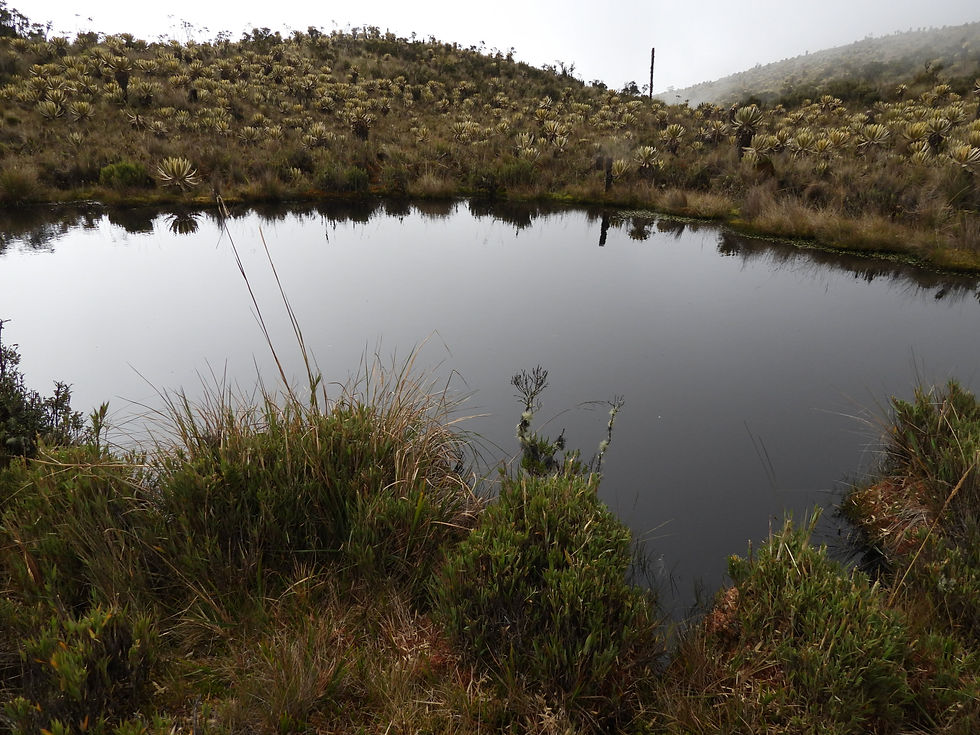
Peatlands may appear as quiet landscapes in the high Andes, but their influence extends far beyond their boundaries. When they function, they stabilize climate and water.When they fail, they amplify risk.
"Understanding peatlands is essential for understanding the future of water and climate resilience in Colombia".
¿'Want to learn more about peatlands in Colombia?
At TECC, we focus on the conservation and restoration of high-Andean peatlands as a nature-based solution for climate and water security.
¡Explore our projects or contact us to collaborate!
The information presented in this article is based on peer-reviewed scientific literature and international environmental frameworks.
References
United Nations Environment Assembly (2019). Resolution 4/16. Conservation and sustainable management of peatlands. United Nations Environment Programme.
Benavides, J.C., Vitt, D.H., & Cooper, D.J. (2023). The High-Elevation Peatlands of the Northern Andes, Colombia. Plants, 12, 955.
Lähteenoja, O., et al. (2012). The large Amazonian peatland carbon sink in the Pastaza-Marañón basin, Peru. Global Change Biology.
FAO & Wetlands International (2012). Peatlands – Guidance for climate change mitigation by conservation, rehabilitation and sustainable use.


Comments