


Peatlands and páramos in Colombia: the hidden key to the country’s water security

Updated: Apr 28
When water security in Colombia is discussed, attention often focuses on rivers, reservoirs, or glaciers. However, one of the most important systems regulating water in the country lies in the high mountains, within the páramo ecosystems, and more specifically in a lesser-known but critical component: peatlands.
These high-elevation wetlands not only store large amounts of carbon but also play a fundamental role in regulating the water that supplies millions of people, support irrigation systems for agriculture, and sustain a large part of the country’s hydroelectric generation.
"Understanding the role of peatlands within páramos is essential to understand the hydrological stability of Colombia".
Colombia: a global páramo powerhouse
Colombia hosts approximately 52% of the world’s páramos, making the country the main global guardian of these unique high-mountain ecosystems.
Páramos function as natural water regulators because their vegetation and soils can store large amounts of water and release it slowly over time, maintaining stable river flows even during dry periods.
It is estimated that:
Páramos supplies water to 16 major cities,
Around 17 million people depend directly on páramo water,
This represents roughly 35% of Colombia’s population.
One of the best-known examples is the Chingaza páramo, which provides about 80% of Bogotá’s drinking water, with flows close to 14,000 liters per second.
Within these ecosystems, peatlands play a central role in maintaining this regulation.
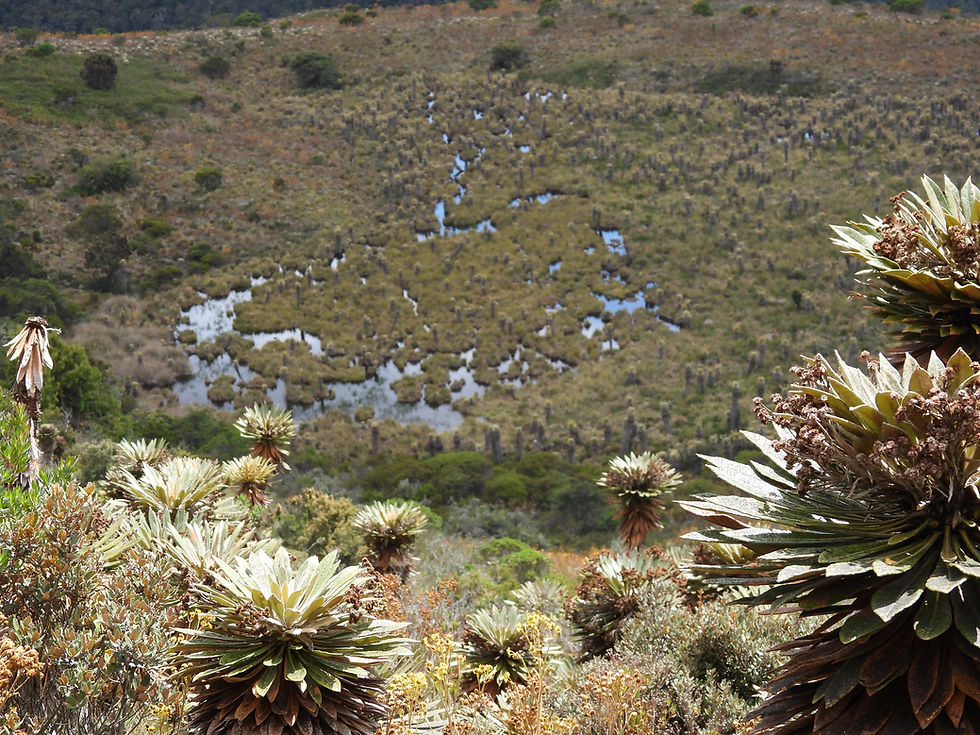
The role of peatlands in water regulation
Peatlands are wetlands where soils remain saturated for long periods, allowing the accumulation of partially decomposed organic material known as peat. In páramos, peatlands act as natural sponges.
Organic soils and vegetation can retain extremely large volumes of water, in some cases up to dozens of times their own weight, and release it slowly into streams, rivers, and aquifers.
This process allows peatlands to:
reduce flood peaks,
maintain river flow during dry seasons,
filter water naturally,
stabilize the hydrological cycle,
reduce vulnerability to climate variability.
"Because of this, peatlands are among the most important components of the Andean water regulation system".

Water for cities, agriculture, and energy
The hydrological regulation provided by páramos supports not only drinking water systems but also key economic sectors.
Studies in Colombia indicate that:
73 hydroelectric plants depend on water originating in páramos,
This represents about 53% of the country’s hydroelectric potential,
173 irrigation districts use water that comes from these high-mountain ecosystems.
This means that páramos — and especially peatlands — sustain:
urban water supply,
agricultural production,
energy generation,
regional economic stability.
"Colombia’s water security begins in its high-elevation organic soils".

Natural reservoirs in a changing climate
Unlike dams or reservoirs, peatlands regulate water naturally and continuously.
Water infiltrates slowly into peat soils, is stored for long periods, and is released gradually, keeping river flows stable throughout the year.
This natural buffering capacity becomes even more important under climate change, when rainfall patterns become more irregular.
Healthy peatlands help:
reduce drought risk,
reduce flood intensity,
maintain baseflow in rivers,
protect downstream communities.
When peatlands are degraded, water drains faster, rivers become more variable, and the risk of water crises increases.

A strategic ecosystem for Colombia’s future
In a warming and more unpredictable climate, conserving páramos and peatlands is not only an environmental priority, but it is also a national security issue.
Millions of people, food production, and energy systems depend on these ecosystems.
Protecting peatlands means:
protecting water,
reducing climate risk,
securing agricultural productivity,
ensuring long-term resilience.
Peatlands may seem small and hidden in the landscape, but they are one of the foundations of Colombia’s stability.
References
Instituto Humboldt – Claves para la gestión local del páramo.
Sarmiento & León – Transición bosque-páramo.
Atlas de páramos de Colombia.
Hydrology of the Andean páramo.
Peatland assessment and peatland hydrology literature.
Work with us to protect peatlands
At TECC, we develop science-based solutions for the conservation and restoration of peatlands in Colombia and the Andes. Our work connects climate mitigation, water security, biodiversity conservation, and sustainable development.
We welcome collaboration with:
researchers,
NGOs,
government institutions,
companies,
local communities,
climate finance partners.
Contact us to explore partnerships and projects.


Comments