


¿What Are Peatlands and Where Can They Be Found in Colombia?

Updated: Sep 22
When we think of forests, glaciers, mangroves, deserts, or reefs, most people can easily visualize them. However, there is a quieter and less visible ecosystem that is fundamental for the planet: peatlands, which are key for climate change mitigation and adaptation, water regulation, and the well-being of society.

But… What Is a Peatland?
A peatland is a type of wetland where, over thousands of years, vegetation has accumulated under constant flooding conditions, that is, in soils that remain saturated with water, forming an organic soil called peat.
Under normal conditions, when a plant dies, it decomposes quickly. But in peatlands, the soil is waterlogged, oxygen levels are very low, and decomposition occurs extremely slowly. This allows plant remains to accumulate layer upon layer, storing carbon in the soil for centuries or even millennia.
In a sense, peatlands function as ecological time machines, preserving the history of past climate and vegetation.
Although peatlands cover only about 3% of the Earth’s land surface, they store nearly one-third of the planet’s soil carbon, making them one of the largest carbon reservoirs in the world.
To put it into real-life perspective:
The carbon stored in the world’s peatlands is equivalent to approximately 50 years of global CO₂ emissions from all humanity at the current rate. In other words, losing that carbon would be like releasing half a century of emissions into the atmosphere.

Why Are Peatlands So Important for the Planet and for Us?
Peatlands perform essential functions for climate, water, and life:
1. Carbon Storage
Peatlands function as enormous carbon banks (carbon sinks). As long as they remain wet and well conserved, carbon stays trapped in the peat for thousands of years.
However, when they are drained, burned, or degraded, that carbon is released in the form of carbon dioxide (CO₂) and other greenhouse gases, contributing to climate change.
At a global scale, peatland degradation represents a significant source of greenhouse gas emissions, despite occupying a small fraction of the Earth’s surface.
2. Water Regulation
Peatlands act as true natural sponges. They absorb water during rainy seasons and release it slowly during dry periods.
This contributes to:
Reducing flood risk
Maintaining flows during the dry season
Sustaining water supply for ecosystems and human communities
In many mountain regions, such as the Andes, their role in water security is fundamental.
In fact, if you live in one of the 16 Colombian capital cities that depend on water coming from páramos, your access to water also depends directly or indirectly on peatlands, which are a key part of these water regulation systems.
And in Colombia?
Colombia is one of the richest countries in high-mountain ecosystems in the world, with approximately 2,800,000 hectares of páramos. In high-Andean zones, peatlands are key components of the landscape.
Recent research in the northern Andes, including Colombia, identified five major types of high-Andean peatlands, dominated by:
Cushion plants
Mosses of the genus Sphagnum
Rushes and sedges
High-Andean grasses
True mosses
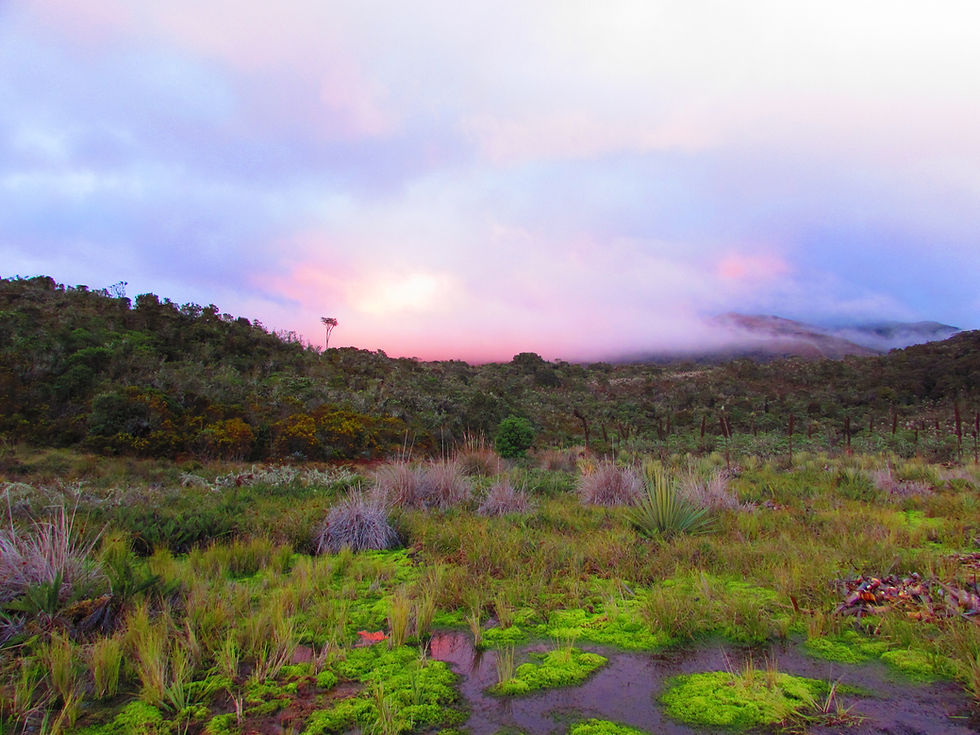
These peatlands are found mainly:
In páramos above 3,000–3,500 m elevation• In natural depressions where water accumulates• In poorly drained high-Andean plains,
In transitions between high-Andean forest and open areas,
In addition to high-mountain peatlands, Colombia also has peatlands in the Amazon and other tropical wet regions, although there remains a significant gap in information and precise mapping.
It is estimated that Colombia could have around six million hectares of peatlands, positioning the country as one of the territories with the greatest climate responsibility in Latin America.
An Invisible but Decisive Ecosystem

Peatlands are not spectacular at first glance. They do not have giant trees or snow-capped mountains. But beneath their dark soils lies carbon accumulated over thousands of years.
“When they are conserved, they help stabilize the climate.”
“When they are degraded, they can become massive sources of emissions.”
Understanding what they are and where they are located is the first step toward protecting them.
In Colombia, where millions of people depend on water regulated by páramos, peatlands are not just another ecosystem—they are a fundamental pillar of our water and climate security.
Want to learn more about peatlands in Colombia?
At TECC, we focus on the conservation and restoration of high-Andean peatlands as a nature-based solution for climate and water security.
¡Explore our projects or contact us to collaborate!
The information presented in this article is based on peer-reviewed scientific literature and international environmental frameworks.
References
United Nations Environment Assembly (2019). Resolution 4/16. Conservation and sustainable management of peatlands. United Nations Environment Programme.
Benavides, J.C., Vitt, D.H., & Cooper, D.J. (2023). The High-Elevation Peatlands of the Northern Andes, Colombia. Plants, 12, 955.
Lähteenoja, O., et al. (2012). The large Amazonian peatland carbon sink in the Pastaza-Marañón basin, Peru. Global Change Biology.
FAO & Wetlands International (2012). Peatlands – Guidance for climate change mitigation by conservation, rehabilitation and sustainable use.


Comments